Best STEM Building Toys for an 8-Year-Old’s Birthday: A Comparison for Parents

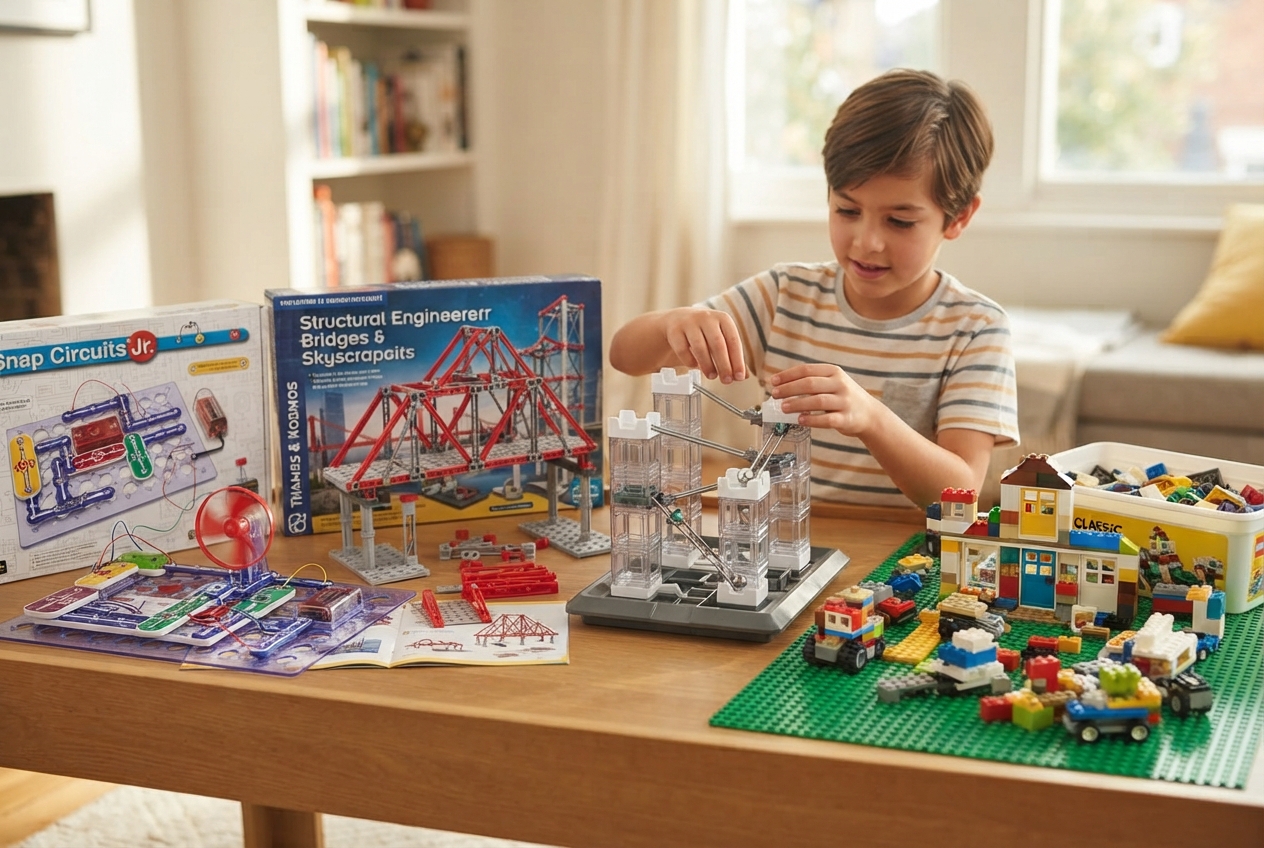
Finding the best STEM building toys for an 8-year-old can feel overwhelming when every box promises brain-boosting fun. You want a birthday gift that actually gets used, matches your child’s attention span, and teaches something real along the way. This comparison walks through nine popular options so you can match a kit to your child’s interests, patience level, and play style.
We judged each option on the skills it targets, the number of projects or challenges included, whether it needs batteries or screens, and how much adult help the assembly may require. Based on the supplied details, here is how they stack up.
Quick Picks
- Best Overall: SNAP CIRCUITS Jr. SC-100 STEM Electronics Kit — a broad, beginner-friendly introduction to circuitry with 100+ projects.
- Best for Building-Brick Fans: SNAP CIRCUITS BRIC Structures STEM Building & Electronics Kit — combines Snap Circuits with compatible building bricks.
- Best for Future Engineers: Thames & Kosmos Structural Engineering: Bridges & Skyscrapers — focuses on force, load, compression, and tension.
- Best Screen-Free Coding Toy: Thames & Kosmos My Robotic Pet: Coding Chameleon — uses color cards instead of an app.
- Best Logic Puzzle: ThinkFun Gravity Maze — a single-player marble logic challenge with 60 cards.
- Best for Laser Science Fans: ThinkFun Laser Maze — directs a real Class 1 laser through mirrors and splitters.
- Best Open-Ended Creative Set: LEGO Classic Large Creative Brick Box 10698 — 790 pieces for free building.
- Best Solar-Powered Kit: Sillbird 12-in-1 Solar Robot Building Kit — builds 12 models powered by sunlight.
- Best Book-and-Build Combo: Klutz LEGO Gear Bots — pairs LEGO Technic elements with papercraft and a 64-page book.
Best Overall — SNAP CIRCUITS Jr. SC-100 STEM Electronics Kit, 100+ Projects, Ages 8+
This kit may be the strongest starting point for most 8-year-olds because it introduces real electronics without soldering or tools. The snap-together parts keep frustration low, and the 100+ project count gives plenty of room to grow.

The SC-100 uses color-coded, numbered modules that snap onto a plastic grid, so kids can follow the manual and see results quickly. The included full-color project manual walks through builds like a flying saucer, and the kit ships with 29 to 30+ Snap Circuits parts depending on the listing details. Because no soldering is required, parents can hand this off with minimal supervision once the child understands the basics.
Key Features
- Builds 100+ electronic projects
- Includes 29–30+ snap-together parts and a full-color manual
- No soldering or tools required
- Recommended for ages 8 and up
- Batteries required (alkaline)
Pros
- Beginner-friendly snap assembly lowers the barrier to entry
- Large project count supports long-term replay value
- Compatible with other Snap Circuits kits for expansion
- Widely recognized with multiple toy and STEM awards
Things to Consider
- Batteries are not included
- Projects follow a manual rather than open-ended free building
- Some younger 8-year-olds may need help reading the manual
Best for: A first electronics kit for a child who likes step-by-step projects and instant results.
Best for Building-Brick Fans — SNAP CIRCUITS BRIC Structures STEM Building & Electronics Kit, Ages 8+
If your child already loves building bricks, this kit bridges that hobby with real circuitry. The Bric-2-snap technology lets kids connect Snap Circuits components to standard building bricks, so their creations can light up, make sounds, and move.
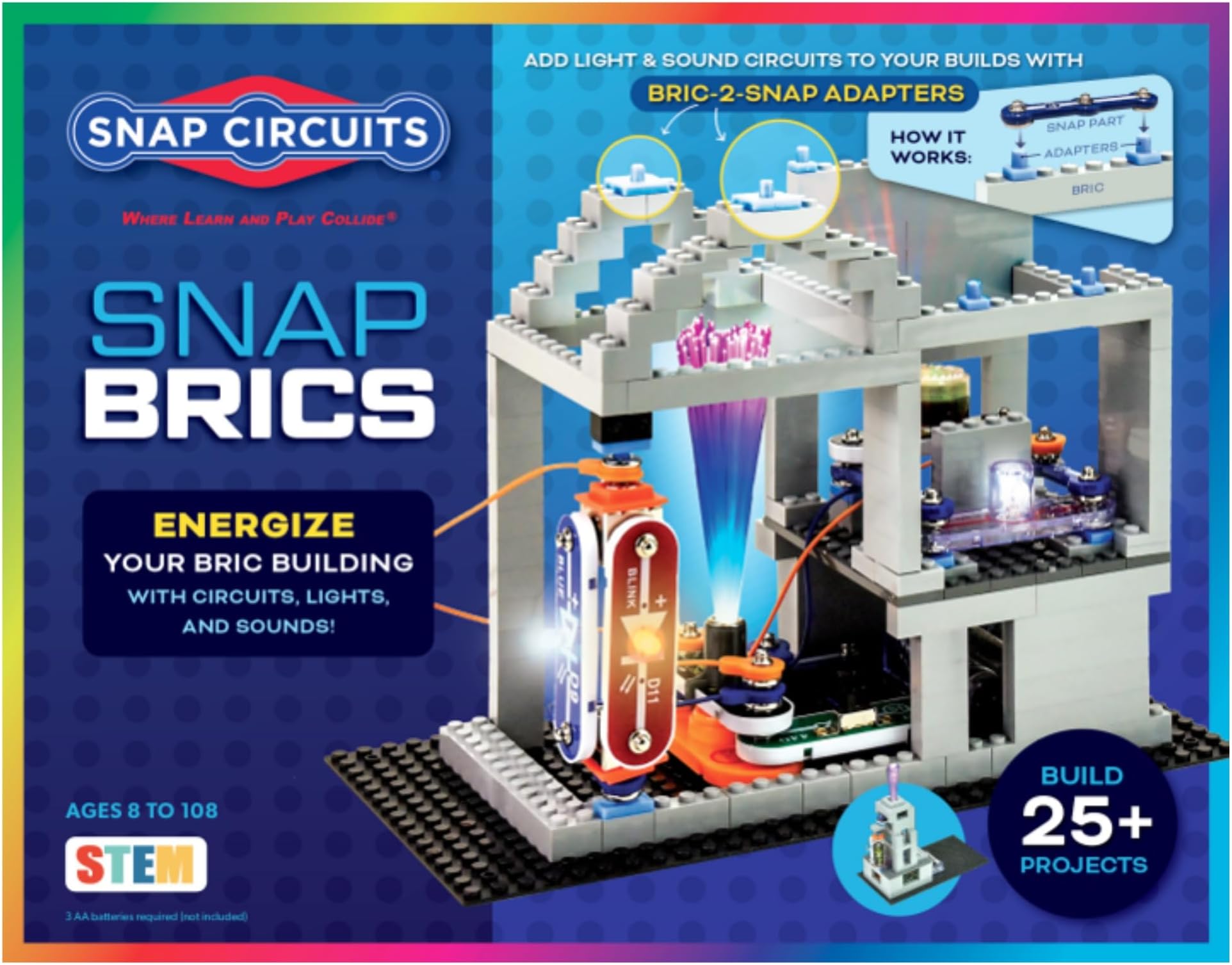
The BRIC Structures kit includes 20 Snap Circuits parts, 75 Bric-2-snap adapters, and over 130 compatible building bricks, plus a full-color idea booklet. That combination supports 20+ engineering projects and leaves room to add your own bricks. The kit requires 3 AA batteries and no soldering or tools.
Key Features
- Combines Snap Circuits electronics with building bricks
- Includes 20 Snap Circuits parts, 75 adapters, and 130+ bricks
- Builds 20+ engineering projects
- No soldering or tools required
- Requires 3 AA batteries
Pros
- Lets brick-loving kids add lights, sound, and motion to builds
- Large brick count supports open-ended creativity
- Works with existing brick collections
- Part of the award-winning Snap Circuits line
Things to Consider
- Batteries are not included
- Project count is lower than the SC-100
- Best suited to kids who already enjoy brick building
Best for: Kids who want to electrify their brick creations rather than follow a pure electronics manual.
Best for Future Engineers — Thames & Kosmos Structural Eng: Bridges & Skyscrapers | Engineering Set
This set targets the physics behind structures. Kids build 20 different models while learning about force, load, compression, and tension, which makes it a strong fit for a child who asks how bridges and towers actually stay up.
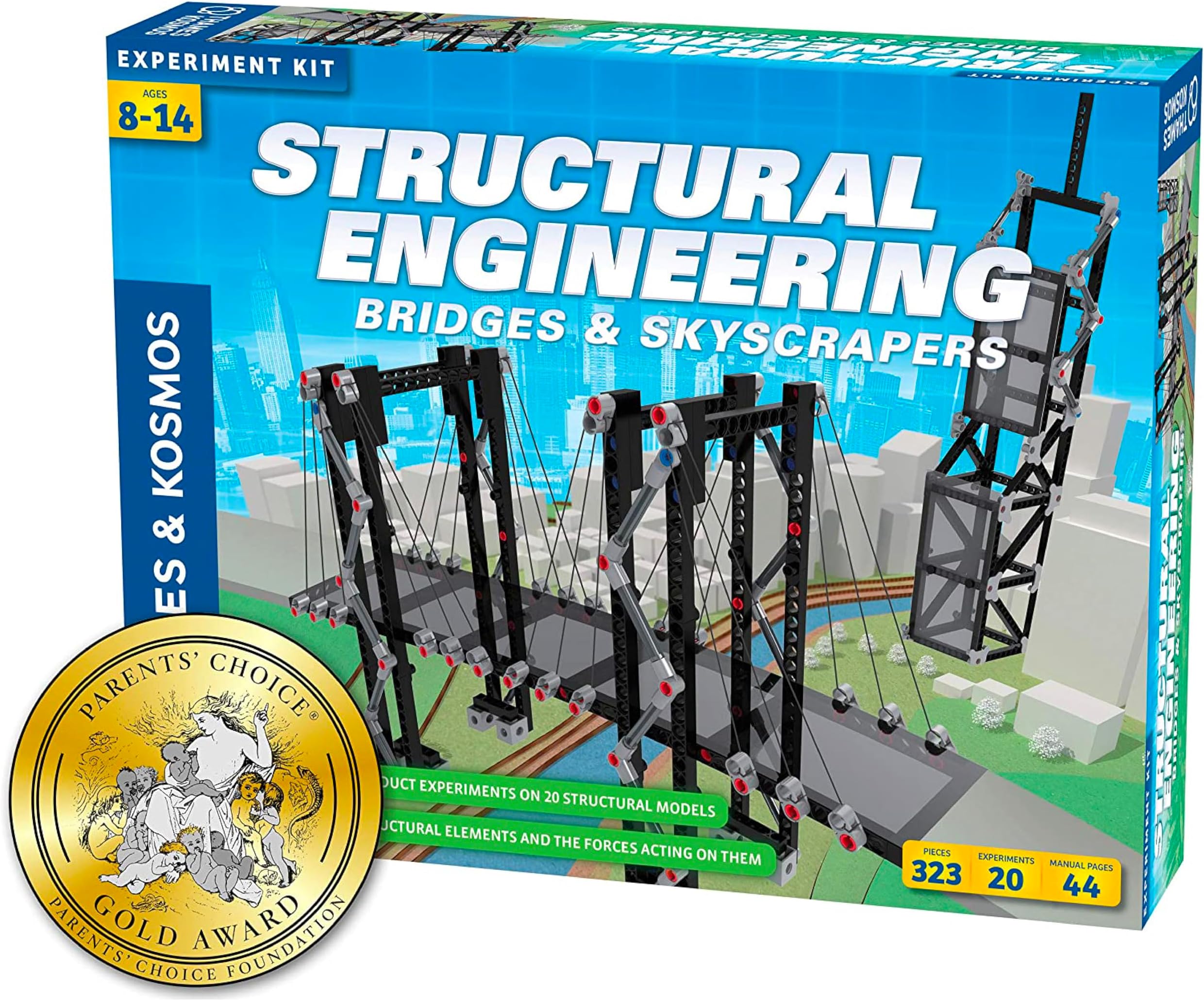
The kit includes over 285 interchangeable building pieces and a 36-page illustrated experiment manual with an assembly guide. The manufacturer lists a skill level of intermediate and a recommended age range of 8 to 14 years. Because the pieces are reusable, kids can rebuild and test variations rather than completing a one-time project.
Key Features
- Builds 20 structural models
- Includes 285+ interchangeable building pieces
- 36-page illustrated experiment manual
- Recommended for ages 8–14
- Intermediate skill level
Pros
- Teaches real engineering concepts like compression and tension
- Reusable pieces support repeated experimentation
- Manual connects builds to physics explanations
- Age range extends into the teen years
Things to Consider
- Intermediate skill level may challenge some 8-year-olds
- Focus is structural engineering rather than electronics or coding
- Adult help may be useful for the first few builds
Best for: A child who enjoys bridges, towers, and understanding why structures hold up.
Best Screen-Free Coding Toy — Thames & Kosmos My Robotic Pet: Coding Chameleon STEM Building & Experiment Kit
This kit stands out because it teaches coding logic without a screen. Kids assemble a 15-inch robotic chameleon, then use physical colored action cards to program its movements, which may appeal to families who want to limit device time.

The chameleon uses a color sensor, infrared sensor, and RGB LEDs. It offers three play modes: Coding Mode for programming sequences, Wild Mode for color-changing camouflage, and Pet Mode for touch reactions. The 133-piece build includes articulated eyes, torso, and leg joints, and the 48-page manual guides assembly. The manufacturer notes ages 8+ with adult help and 12+ for independent play, and the kit requires 4 AAA batteries.
Key Features
- Builds a 15-inch robotic chameleon with 133 pieces
- Screen-free coding with physical color action cards
- Three play modes: Coding, Wild, and Pet
- 48-page manual with assembly and robotics guidance
- Requires 4 AAA batteries
Pros
- Teaches coding logic without screens or apps
- Multiple play modes extend replay value
- Manual connects robotics to nature-inspired design
- Recognized with a 2026 Educational Toy of the Year Award
Things to Consider
- Manufacturer recommends adult help for ages 8+
- Independent play is listed for ages 12+
- Batteries are not included
Best for: Families who want coding practice without handing over a tablet or phone.
Best Logic Puzzle — ThinkFun Gravity Maze – Falling Marble Logic Game
Gravity Maze is a single-player logic game rather than a traditional building kit. Kids arrange towers and a game grid so a marble falls through the maze and reaches the target, which builds planning and spatial reasoning.

The set includes 9 towers, 3 marbles, a game grid, a target piece, and 60 challenge cards that range from beginner to expert. No batteries are required, and the manufacturer recommends it for ages 8 to 15. Because the challenges are card-driven, kids can work at their own pace and revisit harder puzzles later.
Key Features
- 60 challenge cards from beginner to expert
- Includes 9 towers, 3 marbles, game grid, and target piece
- Single-player logic game
- No batteries required
- Recommended for ages 8–15
Pros
- Builds critical thinking and spatial reasoning
- No batteries or screens needed
- Progressive difficulty keeps older kids engaged
- Compact and easy to store
Things to Consider
- Single-player format may not suit kids who prefer group play
- It is a puzzle game rather than an open-ended building kit
- Assembly is required before play
Best for: A child who enjoys brain teasers and solving puzzles independently.
Best for Laser Science Fans — Think Fun Laser Maze (Class 1) Brain Game and STEM Toy
Laser Maze turns light into a puzzle. Kids use mirrors and beam-splitters to direct a real Class 1 laser through a series of mazes and light up the target, which makes abstract physics feel tangible.
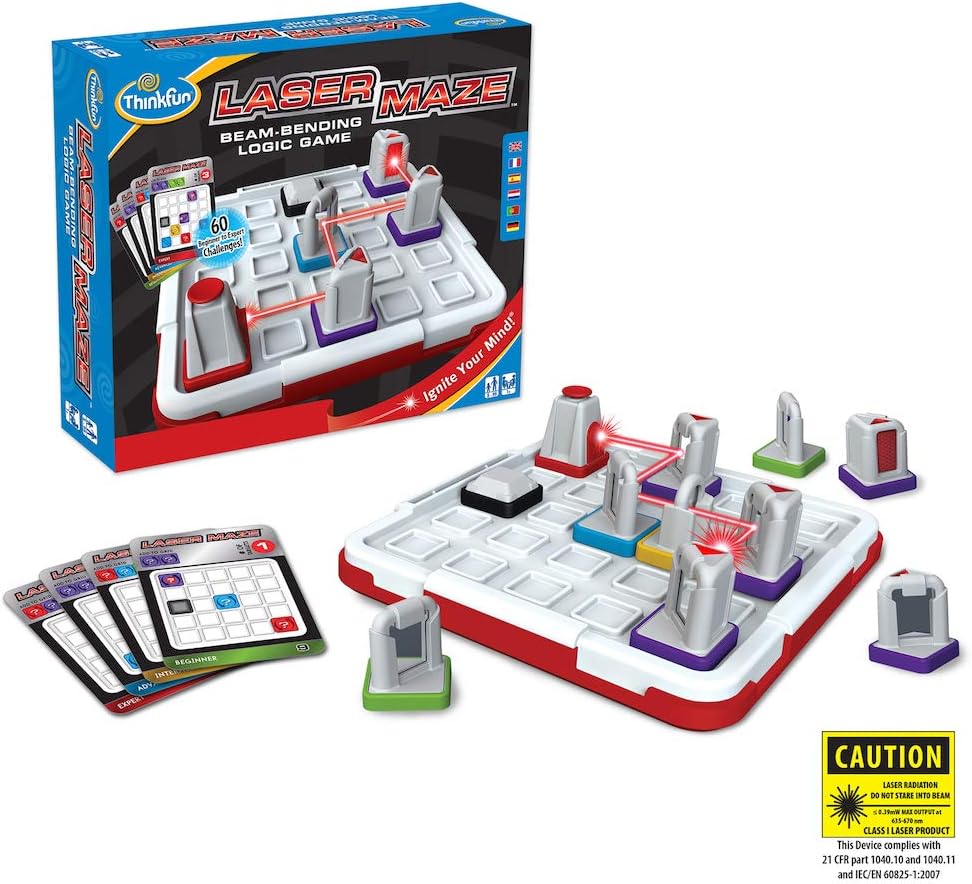
The kit includes a Class 1 laser, 60 challenge cards from beginner to expert, a game board, mirrors, beam-splitters, a cell blocker, and targets. It runs on 2 LR44 batteries, which are included. The manufacturer lists it for ages 8 and up and notes the laser has a maximum output under 0.39 mW at 635–670 nm.
Key Features
- Includes a real Class 1 laser
- 60 challenges from beginner to expert
- Mirrors, beam-splitters, and cell blocker included
- 2 LR44 batteries included
- Recommended for ages 8 and up
Pros
- Turns physics and geometry into hands-on play
- Progressive challenges suit a range of skill levels
- Batteries are included
- Clear instruction manual supports quick start
Things to Consider
- Single-player format
- Laser play requires a flat, indoor surface
- Small mirrors and parts need careful storage
Best for: A child fascinated by light, lasers, and cause-and-effect puzzles.
Best Open-Ended Creative Set — LEGO Classic Large Creative Brick Box 10698
This box is the most flexible option here. With 790 pieces in 33 colors, it supports free building rather than a fixed set of projects, which suits kids who prefer inventing their own designs.
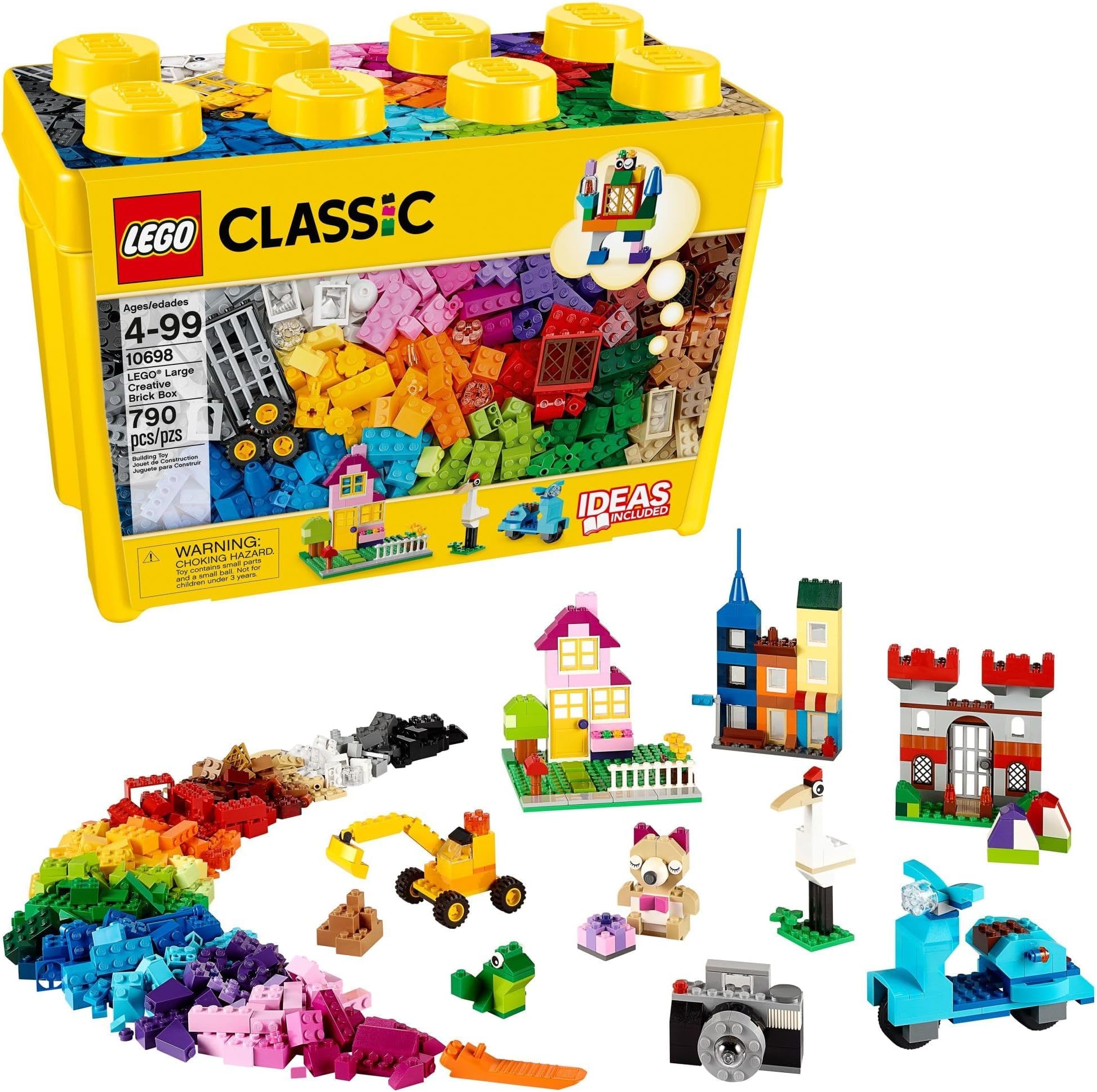
The set includes 8 types of windows and doors, 2 green baseplates, and 6 tires with wheel rims. The packaging doubles as a storage bin, which helps keep pieces contained between play sessions. LEGO lists the set for ages 4 and up, and it is compatible with other LEGO construction sets.
Key Features
- 790 pieces in 33 colors
- Includes windows, doors, baseplates, tires, and wheel rims
- Storage bin packaging
- Compatible with other LEGO sets
- Recommended for ages 4 and up
Pros
- Maximum creative freedom with no fixed instructions
- Large piece count supports big builds
- Storage bin simplifies cleanup
- Works with existing LEGO collections
Things to Consider
- No step-by-step STEM projects or experiments
- Age range starts at 4, so it may feel less advanced for some 8-year-olds
- Small pieces require tidy storage
Best for: A creative builder who wants freedom to invent rather than follow a manual.
Best Solar-Powered Kit — Sillbird 12-in-1 Solar Robot Building Kit STEM Gift for Boys Ages 8-13
This kit teaches renewable energy through building. Kids assemble 12 different models, including robots and cars, and power them with a solar panel or a strong indoor light source.

The set includes 190 parts and an upgraded larger solar panel designed to catch more sunlight. Difficulty levels vary across the 12 builds, so the kit can grow with your child’s skills. Step-by-step instructions are included, and the manufacturer lists it for ages 8 and up, though the recommended age on the listing is 10 years and up.
Key Features
- Builds 12 different models with 190 parts
- Powered by solar energy or strong artificial light
- Upgraded larger solar panel
- Step-by-step instructions included
- No batteries required
Pros
- Teaches renewable energy concepts through play
- 12 builds offer variety and progression
- No batteries needed
- Encourages outdoor play in sunlight
Things to Consider
- Manufacturer recommended age is listed as 10 years and up
- Solar power depends on light conditions
- Small parts require careful storage
Best for: A child curious about solar power and robots who enjoys building multiple models.
Best Book-and-Build Combo — Klutz Lego Gear Bots Science/STEM Activity Kit for 8-12 years
This kit pairs LEGO Technic elements with papercraft and a 64-page book, creating a hybrid experience that teaches physics through hands-on builds. It suits kids who like reading and making at the same time.
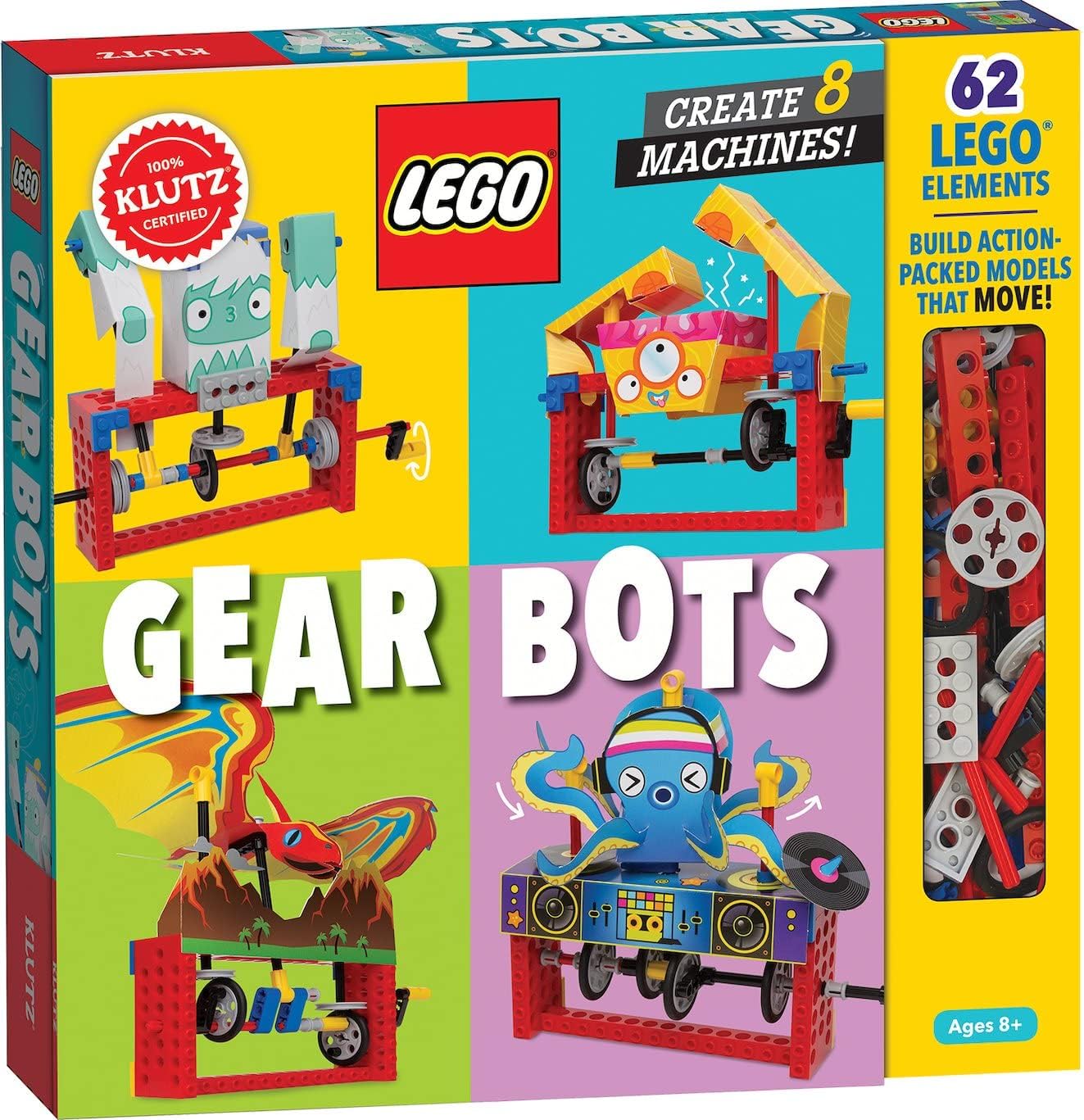
Kids build 8 physics-driven kinetic creatures using LEGO Technic bricks and papercraft. The book covers axles, cams, cranks, and engineering in everyday machines alongside step-by-step instructions. The kit includes 62 LEGO elements and 10 sheets of papercraft, and the manufacturer recommends it for ages 8 to 12.
Key Features
- Builds 8 kinetic creatures
- Includes 62 LEGO elements and 10 sheets of papercraft
- 64-page book with STEM content and instructions
- Covers axles, cams, and cranks
- Recommended for ages 8–12
Pros
- Combines reading, building, and physics learning
- LEGO Technic elements add mechanical realism
- Book explains the engineering behind each build
- Compact and portable
Things to Consider
- Papercraft parts may wear with repeated assembly
- Limited to 8 specific builds
- Single-player focus
Best for: A child who enjoys LEGO Technic and wants to understand the mechanics behind moving models.
Read our detailed review of Klutz Lego Gear Bots Science/STEM Activity Kit for 8-12 years
Product Comparison
| Product | Best for | Key feature | Age range | Important limitation |
|---|---|---|---|---|
| SNAP CIRCUITS Jr. SC-100 | First electronics kit | 100+ projects, no soldering | 8+ | Batteries not included |
| SNAP CIRCUITS BRIC Structures | Brick-loving builders | Combines circuits with building bricks | 8+ | Requires 3 AA batteries |
| Thames & Kosmos Structural Engineering | Future engineers | 20 models teaching force and load | 8–14 | Intermediate skill level |
| Thames & Kosmos Coding Chameleon | Screen-free coding | Color-card coding, 3 play modes | 8+ with help; 12+ solo | Adult help recommended at 8 |
| ThinkFun Gravity Maze | Logic puzzle fans | 60 challenges, marble maze | 8–15 | Single-player only |
| ThinkFun Laser Maze | Laser science fans | Real Class 1 laser, 60 challenges | 8+ | Single-player only |
| LEGO Classic Large Creative Brick Box | Open-ended creativity | 790 pieces, storage bin | 4+ | No guided STEM projects |
| Sillbird 12-in-1 Solar Robot Kit | Solar power learning | 12 models, solar powered | 8+ (listing says 10+) | Needs sunlight or strong light |
| Klutz LEGO Gear Bots | Book-and-build learners | 8 kinetic creatures with book | 8–12 | Papercraft parts may wear |
How to Choose the Right STEM Building Toy for an 8-Year-Old
Start with your child’s interests. A kid who loves taking things apart may gravitate toward the Snap Circuits kits, while a puzzle lover may prefer Gravity Maze or Laser Maze. Matching the toy to existing hobbies increases the odds it gets used past the first week.
Check the recommended age range carefully. Some kits list 8+, while others list 10+ or note that younger kids need adult help. If your child is on the younger end of 8, a kit with adult-assist notes may still work well with you nearby.
Consider whether you want a guided or open-ended experience. Manual-driven kits teach specific concepts step by step, while sets like the LEGO Classic Brick Box encourage free invention. Both have value, but they suit different personalities.
Think about battery and screen requirements. Several kits need batteries that are not included, and a few offer screen-free coding or solar power. If you want to limit screen time, the Coding Chameleon and Sillbird solar kit are worth a closer look.
Finally, weigh replay value. Kits with 60+ challenges or 100+ projects tend to stay in rotation longer than single-build sets. Storage also matters, since small parts are easy to lose.
Final Verdict
Choose the SNAP CIRCUITS Jr. SC-100 if you want a well-rounded first electronics kit with plenty of projects and no soldering.
Choose the SNAP CIRCUITS BRIC Structures kit if your child already loves building bricks and wants to add lights and motion.
Choose Thames & Kosmos Structural Engineering if your child asks how bridges and towers stay standing.
Choose the Thames & Kosmos Coding Chameleon if you want coding practice without a screen.
Choose ThinkFun Gravity Maze or Laser Maze if your child prefers solo brain challenges over open building.
Choose the LEGO Classic Large Creative Brick Box if free building matters more than guided lessons.
Choose the Sillbird 12-in-1 Solar Robot Kit if renewable energy and robots spark your child’s curiosity.
Choose Klutz LEGO Gear Bots if your child likes reading and building side by side.
FAQ
Do these STEM building toys require batteries?
It depends on the kit. The Snap Circuits SC-100 and BRIC Structures kits need batteries that are not included, and the Coding Chameleon requires 4 AAA batteries. Gravity Maze needs no batteries, Laser Maze includes its LR44 batteries, and the Sillbird solar kit runs on sunlight or strong artificial light.
Which kit is best for a child who has never built a STEM toy before?
The SNAP CIRCUITS Jr. SC-100 is a strong starting point because it requires no soldering or tools and includes a full-color manual. Gravity Maze is also beginner-friendly since its challenges start at a beginner level.
Are these kits screen-free?
Most of them are. The Coding Chameleon teaches coding with physical color cards and no screens, and the Sillbird solar kit, Gravity Maze, Laser Maze, and LEGO Classic Brick Box do not require devices.
What age range do these kits target?
Most list ages 8 and up, though the LEGO Classic Brick Box starts at 4, the Structural Engineering set covers 8–14, Gravity Maze covers 8–15, and Klutz LEGO Gear Bots covers 8–12. The Sillbird kit lists 8+ in the description but 10+ in the manufacturer recommendation.