Board Games for 7-Year-Olds Compared: Which Is Right for Your Family Game Night?

Choosing board games for 7-year-olds starts with how your family likes to play. Do you want everyone solving a mystery together, a two-player strategy challenge, or something quick enough to fit before bedtime? Reading demands, player count, playtime, and the style of competition all help narrow your options.
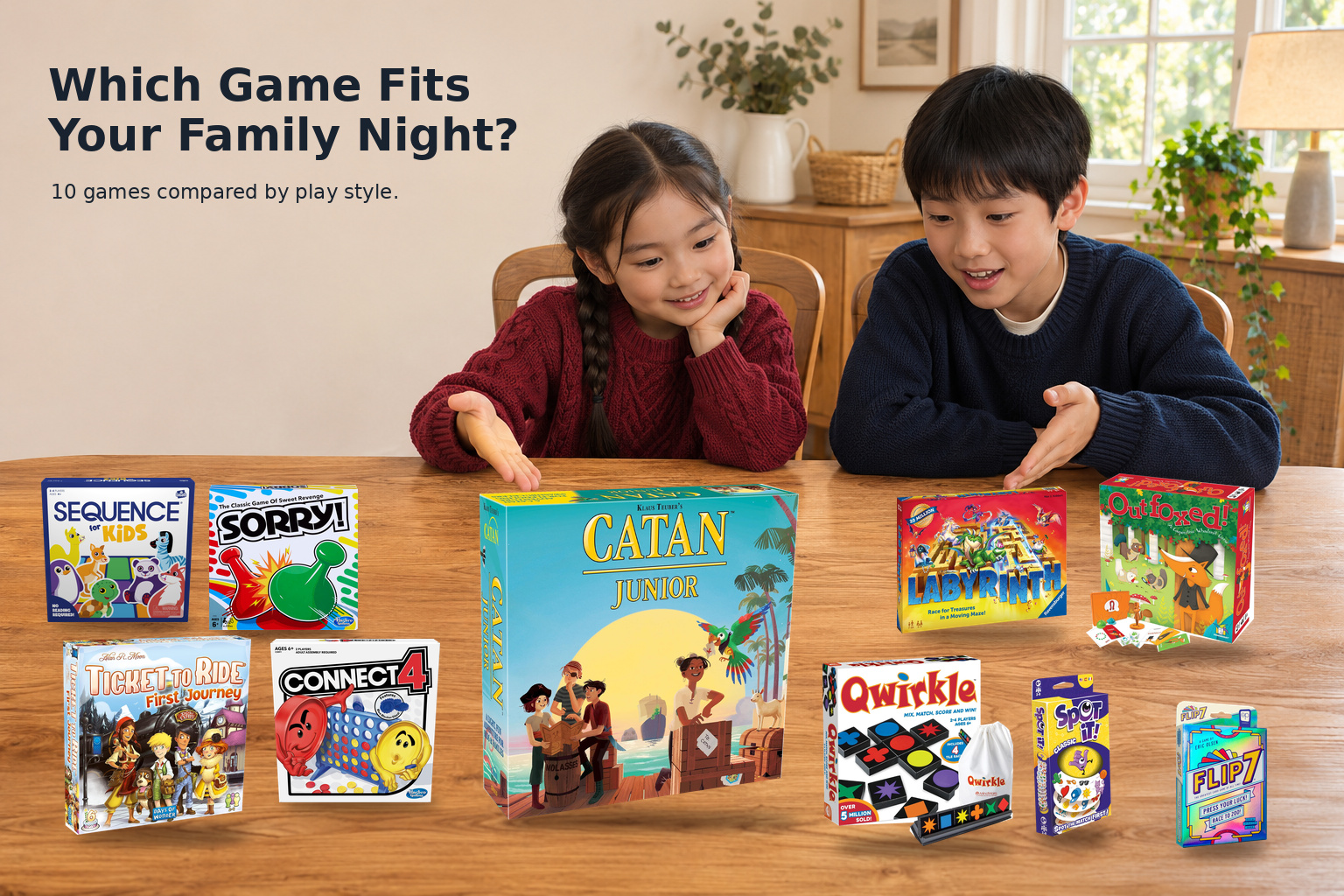
This roundup compares ten supplied games, including two card-game alternatives. There is no single winner for every household. Some records also contain conflicting age or component details, which you will find flagged below. In particular, Flip 7 carries an 8+ recommendation, so it is an older-child option rather than a straightforward age-seven pick.
Quick Picks
- Recommended for reading-free play: Jax SEQUENCE for Kids.
- Recommended for competitive racing: Hasbro Gaming Sorry! Board Game.
- Recommended for two-player strategy: Hasbro Gaming Connect 4.
- Recommended for resource management: CATAN Junior Board Game.
- Recommended for shifting-maze puzzles: Ravensburger Labyrinth Board Game.
- Recommended for railway route building: Days of Wonder Ticket to Ride Europe First Journey.
- Recommended for color-and-shape strategy: MindWare Qwirkle with Trays.
- Recommended for cooperative mysteries: Gamewright Outfoxed! Board Game.
- Recommended for quick, larger-group play: Asmodee Spot It! Classic Eco-Blister Edition.
- Recommended for older-child risk-taking play: USAOPOLY Flip 7 Card Game.
Recommended for reading-free play — Jax SEQUENCE for Kids
If reading gets in the way of joining a game, Jax SEQUENCE for Kids offers a concrete alternative: match a card to a character on the board.
You play a card, place a chip on its matching character, and aim for four chips in a row. That gives your child a visible goal without requiring reading during play. The supplied description targets ages 3–6, so consider this a simpler option for a seven-year-old rather than an automatic next-step challenge.
Key Features
- Supports 2–4 players.
- Reading is not required to play.
- Includes a folding board, 42 cards, and four colors of chips.
Pros
- Character matching avoids a reading requirement.
- The four-in-a-row objective gives you a clear target.
Things to Consider
The age guidance varies across the supplied record, and the description specifically targets younger children. Check whether this level matches your child’s current interests.
Best for: Families prioritizing reading-free matching and a straightforward strategy goal.

Recommended for competitive racing — Hasbro Gaming Sorry! Board Game
Choose Hasbro Gaming Sorry! Board Game if your child enjoys a race with direct setbacks for opponents.
Cards and strategic choices shape your progress toward home. Players can send opposing pawns back to the start, so the interaction involves more than advancing your own pieces. That feature makes your family’s appetite for competitive setbacks an important buying consideration.
Key Features
- Lists ages 6+ and 2–4 players.
- Uses cards to guide a race toward home.
- Includes a board, pawns, cards, and instructions.
Pros
- Accommodates a small family group.
- Combines card outcomes with strategic decisions.
Things to Consider
The title says four pawns per player, while the description says three and the component list gives 12 total. Confirm the edition’s contents and rules rather than relying on the title alone.
Best for: Children who enjoy competitive racing and sending opponents back.

Recommended for two-player strategy — Hasbro Gaming Connect 4
Hasbro Gaming Connect 4 may suit you when game night means one caregiver and one child rather than a whole table.
The product-specific specifications identify a two-player strategy game for ages 6+. This version includes red and yellow discs plus four blue blocker discs. Its two-player format provides a clear distinction from the many group options here; however, the supplied description mistakenly repeats Sorry! information, so those unrelated details do not inform this assessment.
Key Features
- Supports two players.
- Lists ages 6+.
- Includes a grid, supporting feet, slider bar, colored discs, and instructions.
Pros
- Fits one-on-one game sessions.
- Includes four blue blocker discs in addition to the red and yellow sets.
Things to Consider
The two-player limit excludes a full family group playing simultaneously. The supplied description also contains mismatched product information.
Best for: A parent-child strategy session with exactly two participants.

Recommended for resource management — CATAN Junior Board Game
CATAN Junior Board Game may suit your family if you want a pirate-themed introduction to collecting, spending, and trading resources.
You begin with two pirate lairs and build ships to expand your network. Islands generate resources, which you use for more ships, lairs, or help from Coco the Parrot. Market trading adds another decision: use what you have now or exchange it to support your next move.
Key Features
- Lists ages 6+, 2–4 players, and about 30 minutes.
- Combines resource collection, building, and market trading.
- Introduces a simpler style of CATAN play.
Pros
- Connects resource choices to visible network expansion.
- Offers several uses for collected resources.
Things to Consider
Its approximately 30-minute playtime asks for more time than the shortest options here. The resource-and-building focus also differs from a simple matching game.
Best for: Families ready to explore linked strategic decisions through a pirate adventure.

Recommended for shifting-maze puzzles — Ravensburger Labyrinth Board Game
If your child likes finding paths, Ravensburger Labyrinth Board Game makes changing routes the central challenge.
You navigate a shifting maze to reach treasures while also blocking opponents. Because the maze changes during play, you need to reconsider your route instead of treating the board as a fixed puzzle. The supplied description places sessions at approximately 20–30 minutes.
Key Features
- Supports 2–4 players.
- Uses a changing maze and treasure-hunting objectives.
- Includes 34 maze cards, 24 treasure cards, and four playing pieces.
Pros
- Changing pathways create fresh route-planning decisions.
- Combines pursuing treasures with blocking opponents.
Things to Consider
The title and manufacturer age guidance say 7+, but another field lists a minimum age of eight. Check the age label on the edition you choose.
Best for: Children who enjoy spatial puzzles and competitive route planning.

Recommended for railway route building — Days of Wonder Ticket to Ride Europe First Journey
Days of Wonder Ticket to Ride Europe First Journey offers a train-themed option if your child enjoys connecting places on a map.
You collect train cards, claim routes, and connect the cities shown on your tickets. The first player to complete six tickets wins. Its European map gives route-building decisions a geographical setting, while the First Journey format simplifies the broader Ticket to Ride gameplay.
Key Features
- Supports 2–4 players with a listed 15–30-minute playtime.
- Includes a European route map, train cards, tickets, and colored trains.
- Uses six completed tickets as the winning goal.
Pros
- Provides a specific ticket-completion objective.
- Combines card collection with network building.
Things to Consider
The title says ages 6+, while a manufacturer-age field says 13–15. Confirm the exact edition’s age guidance before selecting it for a seven-year-old.
Best for: Train enthusiasts interested in map-based strategy, after checking the edition.

Recommended for color-and-shape strategy — MindWare Qwirkle with Trays
MindWare Qwirkle with Trays may suit your family if matching patterns appeals more than following a story or navigating a map.
You build lines by matching either color or shape and score points along the way. The 108 wooden tiles cover 36 color-symbol combinations. This edition adds trays, which organize your pieces and keep them hidden while you plan.
Key Features
- Includes 108 wooden tiles and four trays.
- Uses color-and-shape matching to build scoring lines.
- The title lists ages 6+ and 2–4 players.
Pros
- Offers both color and shape as matching criteria.
- Includes trays for organization and concealed pieces.
Things to Consider
Player-count information conflicts: the title and highlight say 2–4, while a specification field says two. Confirm the rules for this edition if group capacity matters.
Best for: Families seeking tile-based pattern matching with scoring decisions.

Recommended for cooperative mysteries — Gamewright Outfoxed! Board Game
Gamewright Outfoxed! Board Game stands apart when you want your family solving a shared problem rather than defeating one another.
You work together to catch a fox before it escapes. Rolling dice, collecting clues, using a decoder, and eliminating suspects give the group concrete steps to discuss. That cooperative structure makes it a relevant alternative to the direct competition in Sorry! or Labyrinth.
Key Features
- Cooperative clue-solving with dice and a decoder.
- The description lists ages 5+.
- The supplied player count is four.
Pros
- Gives players a shared objective.
- Combines collecting clues with eliminating suspects.
Things to Consider
The description gives 15–20-minute sessions, while a specification says 30 minutes. Allow flexibility rather than treating the shorter estimate as guaranteed.
Best for: Families who prefer teamwork and discussing clues together.

Recommended for quick, larger-group play — Asmodee Spot It! Classic Eco-Blister Edition
Asmodee Spot It! Classic Eco-Blister Edition is a card-game alternative when you need a short activity for more than four people.
Players race to identify the matching symbol between two cards. Five included variations give you different ways to use that central observation challenge. With a listed ten-minute playtime and capacity for up to eight players, it serves a different role from the longer board games here.
Key Features
- Lists ages 6+, 2–8 players, and ten-minute playtime.
- Includes five gameplay variations.
- Comes with 55 cards, a rulebook, and a tin.
Pros
- Accommodates the largest explicitly bounded group here.
- Offers several variations in one set.
Things to Consider
This is a fast visual-matching card game, not a board-based adventure. Reaction speed forms part of its appeal.
Best for: Larger family gatherings and brief, energetic matching sessions.

Recommended for older-child risk-taking play — USAOPOLY Flip 7 Card Game
USAOPOLY Flip 7 Card Game belongs on your older-child shortlist, not your default list for seven-year-olds: the supplied manufacturer recommendation is 8+.
You decide whether to keep receiving cards or protect your points. Duplicate numbers can bust your round, while action and modifier cards introduce additional twists. The goal is to reach 200 points first, making risk management and number totals central to play.
Key Features
- Lists 3+ players and approximately 20 minutes.
- Includes 94 cards and rules.
- Features Flip Three, Freeze, Second Chance, and score modifiers.
Pros
- Centers decisions on whether to continue or stop.
- Includes action cards alongside numbered cards.
Things to Consider
The 8+ guidance places it above the target age. It also requires at least three players, unlike the two-player-compatible options.
Best for: Families also shopping for older siblings who enjoy press-your-luck card games.

Product Comparison
| Product | Recommended use | Key feature |
|---|---|---|
| Jax SEQUENCE for Kids | Reading-free play | Match characters and form four-chip rows |
| Hasbro Gaming Sorry! Board Game | Competitive racing | Send opponents’ pawns back to start |
| Hasbro Gaming Connect 4 | Two-player strategy | Grid and colored discs, including blockers |
| CATAN Junior Board Game | Resource management | Collect, trade, and build a pirate network |
| Ravensburger Labyrinth Board Game | Spatial route planning | Shifting maze and treasure objectives |
| Days of Wonder Ticket to Ride Europe First Journey | Railway route building | Connect cities to complete tickets |
| MindWare Qwirkle with Trays | Pattern-based strategy | Wooden matching tiles and four trays |
| Gamewright Outfoxed! Board Game | Cooperative deduction | Collect clues and eliminate suspects |
| Asmodee Spot It! Classic Eco-Blister Edition | Quick group sessions | Five visual-matching variations |
| USAOPOLY Flip 7 Card Game | Older-child risk decisions | Press-your-luck scoring; ages 8+ |
How to Choose the Right Board Games for 7-Year-Olds
Start with your usual player count
Connect 4 fits exactly two participants. Spot It! accommodates 2–8, while Flip 7 starts at three. Check conflicting capacity details before choosing Qwirkle for a particular group.
Decide between cooperation and competition
Outfoxed! gives you a shared mystery. Sorry! lets players send opponents backward, and Labyrinth includes blocking. Choose the interaction your child actually enjoys.
Match the activity to your available time
Spot It! lists ten minutes; CATAN Junior lists about 30. Treat estimates as planning guides, especially where the supplied playtimes conflict.
Consider the kind of thinking your child prefers
Qwirkle emphasizes color-and-shape patterns, Labyrinth uses changing paths, and CATAN Junior connects resources to building. A familiar interest can help you narrow the field without assuming all strategy games feel alike.
Check reading demands and age guidance separately
SEQUENCE explicitly requires no reading. Do not assume the same for every other game. Also check the edition’s age label where records conflict; Flip 7 clearly sits above age seven.
Final Verdict
When comparing board games for 7-year-olds, choose the play style first. Choose Gamewright Outfoxed! Board Game if your priority is teamwork. Choose CATAN Junior Board Game if resource management and pirate-themed building appeal to your child.
Choose Hasbro Gaming Connect 4 for one-on-one strategy, or Asmodee Spot It! Classic Eco-Blister Edition for short sessions with a larger group. Keep USAOPOLY Flip 7 Card Game as an older-child option rather than treating it as interchangeable with the age-six-plus choices.
FAQ
Which option explicitly requires no reading?
Jax SEQUENCE for Kids states that reading is not required. Its gameplay uses cards matched to characters on the board.
Which game lets everyone work together?
Gamewright Outfoxed! Board Game uses cooperative play. Your group collects clues and eliminates suspects to catch the fox before it escapes.
Which option supports more than four players?
Asmodee Spot It! Classic Eco-Blister Edition explicitly supports 2–8 players. USAOPOLY Flip 7 Card Game lists 3+ players, but its supplied details do not specify an upper limit.
Does Flip 7 meet an age-seven recommendation?
USAOPOLY Flip 7 Card Game lists a manufacturer recommendation of eight years and up. It is therefore not an age-seven match based on the supplied guidance.